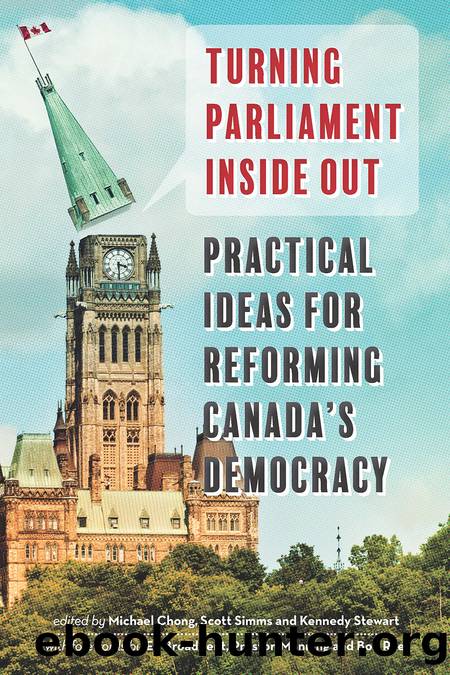
Turning Parliament Inside Out: Practical Ideas for Reforming Canada's Democracy by Michael Chong & Scott Sims & Stewart Kennedy
Author:Michael Chong & Scott Sims & Stewart Kennedy [Chong, Michael & Sims, Scott & Kennedy, Stewart]
Language: eng
Format: epub
Tags: Politics
ISBN: 9781771621373
Goodreads: 35168881
Publisher: Douglas & McIntyre
Published: 2017-05-13T00:00:00+00:00
Green
12
1
12.00
NDP
67
44
1.52
Bloc Québécois
6
10
0.60
Conservatives
52
97
0.54
Liberals
72
180
0.40
Independents
0
1
0.00
Vacant
0
5
0.00
Total
209
338
0.62
Table 3 shows opposition MPs submit more e-petitions than those sitting on the government side of the House. When looking at the 209 approved e-petitions on a per party basis, Elizabeth Mayâs member-of-one Green Party has generated the most petitions per MP, followed by the NDP with almost one-and-a-half petitions per MP in the first year of the program. The Conservatives and the Bloc have yet to fully embrace this system, although it is important to keep in mind the Bloc usually confines itself to activities in Quebec.
If the UK experience is any guide, we can expect many more Canadians to submit e-petitions in the future. The UK system started slowly and then took off once the system became better known. That the Canadian system promotes quality over quantity is also a step forward for e-petitioningâwith frivolous petitions being kept to a minimum. On a personal note, I couldnât be more pleased with how the system is progressing now that I see the effort has gone some ways to reducing Canadaâs democratic deficit.
What Needs to Change?
The e-petition story provides a model for how the House of Commons can function more democratically. With e-petitions, my team put forward a well-researched and considered private memberâs proposal and canvassed all MPs for support in good faith, regardless of their political stripe. In return, many non-NDP MPs took off their party hats and supported my motion. In lending full caucus support, the Liberals, Bloc and Greens took a small risk in supporting an idea from a member of a party with which they would compete for votes in future elections. This showed a willingness to throw off partisan cloaks to improve democracy.
Opposition MPs risked no repercussions from their party leadership teams, since e-petitioning was supported by party leaders. The real risk-takers were the backbench Conservatives who jeopardized their future advancement within the party when they voted for my motion. Private discussions revealed all of them suffered in one way or another for voting the way they did, as I did within my party for supporting and jointly seconding their bills and motions. I think most Canadians would agree this seems wrong and needs to change.
Zooming back out to the larger picture of how our parliamentary democracy works, if we transported an MP sitting in the House of Commons in 1867 through time to the present day, that MP would not recognize the procedures followed in todayâs House of Commons and would be shocked at how little freedom there is to raise local issues. Likewise, a twenty-first century MP transported back to the post-Confederation Commons would likely get lost in the leeway and independence. Put these time-travelling MPs together to discuss their experiences and I am sure they would agree that a better balance must be struck between a House of Commons where MPs are so independent that the country is ungovernable and a House where MPs cannot even sit or stand without permission from their party leaders.
One way to lessen party control would
Download
This site does not store any files on its server. We only index and link to content provided by other sites. Please contact the content providers to delete copyright contents if any and email us, we'll remove relevant links or contents immediately.
| Arms Control | Diplomacy |
| Security | Trades & Tariffs |
| Treaties | African |
| Asian | Australian & Oceanian |
| Canadian | Caribbean & Latin American |
| European | Middle Eastern |
| Russian & Former Soviet Union |
The Secret History by Donna Tartt(19034)
The Social Justice Warrior Handbook by Lisa De Pasquale(12183)
Thirteen Reasons Why by Jay Asher(8885)
This Is How You Lose Her by Junot Diaz(6873)
Weapons of Math Destruction by Cathy O'Neil(6261)
Zero to One by Peter Thiel(5784)
Beartown by Fredrik Backman(5734)
The Myth of the Strong Leader by Archie Brown(5495)
The Fire Next Time by James Baldwin(5426)
How Democracies Die by Steven Levitsky & Daniel Ziblatt(5211)
Promise Me, Dad by Joe Biden(5141)
Stone's Rules by Roger Stone(5080)
A Higher Loyalty: Truth, Lies, and Leadership by James Comey(4947)
100 Deadly Skills by Clint Emerson(4915)
Rise and Kill First by Ronen Bergman(4776)
Secrecy World by Jake Bernstein(4739)
The David Icke Guide to the Global Conspiracy (and how to end it) by David Icke(4697)
The Farm by Tom Rob Smith(4501)
The Doomsday Machine by Daniel Ellsberg(4482)
